
|
|
|
 |
|
|
 |
|
AN INTRODUCTION
mong the many of its treasures that
Ireland has shared with the world, are several beloved breeds of dogs.
Among them are four beguiling terriers and perhaps least known of them
is the Glen of Imaal Terrier. It has been described variously as a
rough-and-ready Sealyham, a miniature Irish Wolfhound, or a Soft Coated
Wheaten on short legs, etc. While these descriptions might allude to an
aspect of the Glen of Imaal’s profile, they ultimately miss the point.
The Glen isn’t a rough-and-ready or miniature anything. It predates many
of the breeds to which it is likened and is a truly unique and
remarkable creature beloved by most everyone fortunate enough to come
into contact with one.
The history of the breed finds its roots
in the starkly beautiful Glen of Imaal in County Wicklow. Like its three
Irish cousins--the Kerry Blue Terrier, the Soft Coated Wheaten Terrier
and the Irish Terrier--the Glen of Imaal Terrier was initially bred to
rid the home and farm of vermin, and hunt fox and badger. The European
badger weighs in at 40 lbs and the Glen was tough and strong enough to
go to ground and dispatch the vermin soundlessly.
According to legend the Glen of Imaal
also has a unique task which it was expressly designed for: it was a
turnspit dog. The turnspit was a large wheel which, when paddled by the
dog, would turn the spit over the hearth--a canine-propelled
rotisserie, if you will. The Glen’s highly individualized bowed front
legs and powerful hindquarters were ideally suited for this. For several
hundred years, these hearty dogs performed their tasks unnoticed by all
except those who treasured them. With the advent of dog shows in the
20th century, the breed began to
emerge into the public eye. In 1934, the Glen of Imaal Terrier was given
full recognition by the Irish Kennel Club. It was the third of the four
Irish terrier breeds to be so acknowledged. The breed is now recognized
by the Kennel Club of Great Britain, FCI, and several rare breed
associations. In America the Glen was fully recognized and entered the
Terrier Group in October 2004 though the hard efforts of members of the
Glen of Imaal Terrier Club of America. There are 500-600 Glens
registered in the United States.
Owning a Glen of Imaal
Terrier can be a unique and rewarding experience...but it is not the
breed for everyone. Read on to determine if it might be the right
breed for you. . Harold

Gay/R.B.T.(Int) |
|
|

|
DESCRIPTION
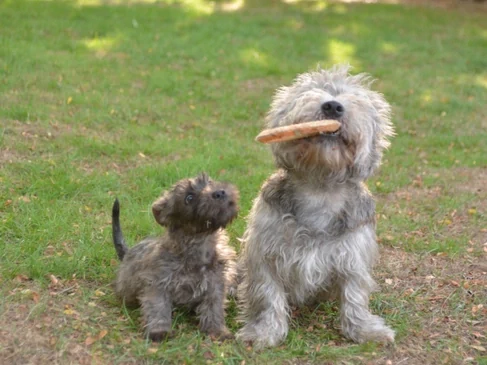
The Glen is a big dog on short legs. It stands up to 14" at the
withers (the point where the neck meets the back) and weighs between
32-40 lbs. It should always give the impression of great substance
for its size. Longer than tall, it carries a double coat: a harsher
outer coat and a soft under coat. The topknot and furnishings are
softer. Its front legs are bowed--like Chippendale furniture --
with front feet pointing to 10 and 2 o’clock.turning . Its ears
are rose or semi-prick when alert. Its unique topline rises to a
strong loin, with no dip or slackness behind the withers and no drop-off
at the croup. The hindquarters are extraordinarily well-muscled. The
docked tail is set high and carried erect. Accepted colors are
wheaten (any shade), blue, and brindle, the most commonly seen being
blue brindle, (the most desirable being a bleu brindle a mixture of
dark-slate blue, lighter blue undercoat and hints of tan. |
|
|

|
|
|
CHARACTERISTICS
t is always risky to generalize
about any group of living things, especially breeds of dogs. Exceptions
always exist. There are, however, several character traits which it is
fair to say the Glen of Imaal Terrier possesses. They are hardy and
resilient--some of us would say "stoic." They are inclined not to bark
much.
Indeed, they were bred to be silent when
working. That said, if other dogs in the household are prone to sounding
off, a Glen will join the chorus. When they do bark, it is a
surprisingly deep and resonant sound, suggesting a dog much larger than
they are. For this reason alone, some people find them to be suitable
watch (not guard)dogs. They tend to make their own exercise and are
equally at home on acres of land or in an urban apartment. They love a
good walk (not a jog as their short legs couldn't keep up), a romp in
the park or through the woods, and especially love a good car ride.
Reports of car sickness or drooling are rare.
Glens are game. Other furry creatures
are often seen as prey. They are terriers, after all. And like most
terriers, that gameness can be expressed as aggressiveness towards other
canines who are perceived as adversaries. It has often been said that a
Glen will rarely start a fight but is likely to finish it. Yet many
Glens live happily in the company of other dogs...some even with cats
especially if they were raised together.. Proper introduction,
supervision and instruction are required. Many Glens are not suited for
the dog park, but make excellent loving pets.
Like many terriers, Glens can be
stubborn and have an independent streak. They respond enthusiastically
to praise and dramatically to a scolding. With time and patience they
make great agility dogs.
Glens are inquisitive. Many Glen owners
would say that their dogs are also naive about traffic. A fenced yard,
and always walking
a Glen on lead, are essential. Invisible fences will work only under
supervision as the prey drive to chase the squirrel out does the jolt of
the fence.Glens can be diggers so ideal fencing should have a sound
foundation.Caution should be taken around swimming pools. Though many
Glens love the water,most are not strong swimmers due to their heavy
weight on very short legs. Glens have drowned
Glens tend not to be hyper. Many, in
fact, could easily be considered bona fide " couch potatoes”. Yet they
can be extravagantly silly and full of pluck, finding pleasure in the
most peculiar (to us) preoccupations. Some entertain themselves by just
running in circles.They are adoring of children, but it should be
remembered that a 35 pound, well-muscled dog can easily knock over a
young child. It is unlikely that such a youngster could control a Glen
on a lead.
Simply put, Glens are most often
quite easy to live with, and they are extremely easy to love. While not
constantly demanding attention, they adore human contact and return the
gesture with gentleness and forbearing. |
 |
|
GROOMING
hough the Glen does not require
that you have the skill with scissors needed to groom a Kerry Blue or a
Soft Coated Wheaten, nor the skill with a stripping knife required to
groom an Irish Terrier, it does require grooming. A Glen’s outer coat
will grow to 3-4" if left unattended and it will matt, if left
un-brushed or un-combed. Technically speaking a Glens can shed.
Practically speaking, it’s virtually unnoticeable if brushed
and striped out once or twice annually.
A thorough brushing with a slicker
brush, once or twice weekly, will remove a substantial
hair. Raking the coat with a stripping knife used like a comb will
remove the undercoat that’s ready to come out. The neck,
back, tail, and earsshould be stripped every six to nine months. Your
breeder can give you instructions. Once you and your Glen get the knack
of it, it shouldn’t take more than an hour once or twice a year.Trimming
for show is a bit more intensive. Once again, your breeder can walk you
through the process. Nails as for all dogs need to be kept trimmed. And
like most terriers, Glens grow hair in their ear canals that needs to be
plucked routinely. Bathing is not required with any degree of frequency.
Purists will say that it softens the coat and should be avoided when
possible. |
|
|

|
|
HEALTH
any sources cite that the Glen
is free of hereditary defects. This is probably a gross overstatement.
Any breed of dog carries recessive genes for a host of universal canine
defects that can and will emerge. It is true, however, that the Glen has
been particularly fortunate in this regard...SO FAR!
Incidents of an eye
disorder, PRA (progressive retinal atrophy) have been reported.
Extensive testing of American stock confirmed that the incidents of the
disease are isolated so far. All breeding stock should test clear or not
be bred. However, current testing only detects afflicted stock, not
carriers. We hope to benefit from current DNA research being done at
Cornell University here in America which will enable breeders to do a
simple DNA test to identify carriers. There is a similar DNA research
program going on in the UK as well.
Hip
dysplasia, common to most breeds, has been identified in Glens as well.
Testing for it by x-ray is done by respected breeders. In fact, breeders
with the Glen of Imaal Terrier Club of America sign a breeders Code of
Ethics stating that all their breeding stock is tested prior to
breeding. Breeders are also committed to a frank exchange of information
and submit test results to an international data base. A common
problem among all terriers, and the Glen is no exception, are skin
irritations. In most cases, the eruptions are a result of flea
allergies. There appears to be a genetic predisposition to such allergic
reactions. Your breeder can provide you with history of this problem—if
it exists- in the lines of his/her breeding program. |
|

|
FINDING A PUP
he Glen of Imaal Terrier remains
a rare breed throughout the world. Litters are relatively few in number.
Most breeders have a long waiting list of prospective new owners. The
Glen of Imaal Terrier Club of America provides a breeder referral
service. Commencing a dialogue with a few breeders whose stock you like
is highly recommended. Visiting breeders and attending dog
shows also provide an opportunity to meet a Glen
You should feel free to ask your breeder
any and all questions you have. There are no silly questions. Similarly,
the breeder will likely ask you many questions about your home, family,
schedule, interests and experience with terriers, many times in the form
of a written application. It is also unlikely that you will be able to
pick the pup you want from a litter. It is far more likely that a pup or
two will be selected, based on the breeders assessment of what would
work best for you given the information you have provided
Cost varies some by region--as do vet
costs Given the rarity of the breed and the consequential
rarity of stud dogs, matings are often long distance affairs
(many international!). In addition, breeders will often hold on to
pups until 9 or 12 weeks old to best be able to assess the litter,
thereby incurring greater vet and food expense, All of this is
costly and despite the price of a puppy breeders do not breed to
make a profit as there is none, but breed because they are dedicated
to breeding the best Glens possible. Whatever the cost, your initial
investment will be, over the 10-15 year life span of your Glen, your
smallest investment. Veterinary expenses, food, supplies and all
those little luxuries that you decide your Glen must have, will add
up to a substantial amount over time. Dog ownership is indeed a
financial commitment. Your breeder should provide you with
appropriate registrations documents, veterinarian history, feeding
and grooming information and a sales contract. This is the beginning
of a relationship not only with your Glen, but also with your
breeder. So choose both carefully
. |
|

|
|
AN OLDER DOG?
Very rarely an older dog, one over a year of age, might come
available. This Glen was perhaps a show prospect that didn’t work out,
or is a dog retired from breeding or showing. These Glens are often
housebroken, socialized, and trained. If the rigors of puppy-hood are
daunting to you, this might be an option to consider. Rescued Glens are
fortunately few and far between. They usually originated as imported
stock from another country and might have extensive issues that need to
be dealt with by anyone taking on a rescued dog.
THE GLEN IN PRINT
There are few commercially published books devoted to the Glen. One
self published book is by the late Eithne Cleary, truly one of the
pioneers of the breed in Ireland, is called THE IRISH GLEN OF IMAAL
TERRIER REFERENCE BOOK. Unfortunately it is out of print. Another
excellent book, also out of print is THE DOGS OF IRELAND by Anna Redlich.
Googling might find you a seller of them. Several of the newer dog
encyclopedias also have an entry for the Glen.
|
 |
|
|
Copyright GITCA 2001 - -Visitor number |
|
|
|
 |
|